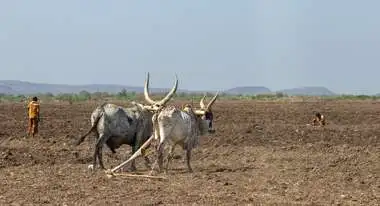
Appeal by Welthungerhilfe (WHH)
El Niño: Act Before Weather Extremes Become Hunger Crises
The climate phenomenon El Niño is expected to disrupt weather patterns in many parts of the world in the coming months, bringing droughts, floods and extreme heat. For millions of people, this could mean crop failures, water shortages, or homes and farmland being flooded. Enter: Welthungerhilfe's “11 for 11” El Niño Appeal, of which WHH and partners are preparing for the potential humanitarian consequences. The aim is to provide assistance as early as possible – before people lose their crops, livestock or other sources of livelihood.

El Niño occurs when waters in the Pacific Ocean between Australia and South America become warmer due to weaker winds. This affects temperatures and precipitation far beyond the Pacific, altering weather patterns in many parts of the world. El Niño occurs irregularly, typically every two to seven years. Scientists currently expect the upcoming El Niño to be particularly strong over the coming months, potentially lasting until around March 2027.
El Niño does not affect all regions in the same way. While parts of southern Africa and Southeast Asia face the risk of drought and extreme heat, parts of East Africa are at increased risk of heavy rainfall, flooding and landslides. For people whose livelihoods depend on agriculture, both extremes can be devastating: too little rain can cause crops to wither and livestock to die, while excessive rainfall can destroy farmland, homes and roads. The impacts are particularly severe for people who are already facing hunger, poverty, conflict or displacement.
When Water Becomes a Threat: Dalmar’s Experience of El Niño

WHH staff member Dalmar Abdi Keysane experienced the effects of the climate phenomenon firsthand in Somalia. As a child, he lived through the 1997/1998 El Niño, when extreme rainfall caused widespread flooding across the Horn of Africa.
“Large areas were covered by enormous amounts of water. People gathered on the few areas that were slightly higher, crowded together because everything else was under water,” he recalls. “You can imagine what it looked like: there were no sanitation facilities, no water supply, no electricity. The number of rapes, thefts, robberies and other crimes increased. Malaria was another problem, because the floods caused mosquito populations to increase dramatically. Many people became ill, and there was not enough medicine.”
I remember that those who could afford it fried onions. If you could get onions, you were already among the better-off families in the area.
Dalmar Abdi Keysane WHH Area Manager South/Central SomaliaDalmar recalls how the floods disrupted supplies because roads remained impassable for months. Food and medicine could barely reach many communities. As a result, many children suffered from malnutrition because they lacked sufficient and balanced food. The United Nations and other humanitarian organizations tried to assist people by dropping food from aircraft over certain areas.

“I remember that those who could afford it fried onions. If you could get onions, you were already among the better-off families in the area. You could prepare them with vegetable oil and salt and eat them with injera [Ethiopian flatbread] or whatever else you had. That was the only kind of soup people could afford,” Dalmar says.
“It was a very, very difficult situation – an almost unbearable experience for a young child who had to witness all of this and live through it.”
WHH Launches “11 for 11” El Niño Appeal
To help prevent such experiences from being repeated, WHH aims to act where the severe impacts of El Niño are already becoming apparent.
Through its “11 for 11” appeal, WHH aims to mobilize €11 million for measures in eleven high-risk countries across Africa, Asia and the Caribbean. WHH teams and partner organizations in Burkina Faso, Madagascar, Malawi, Mali, Niger, Uganda, Zimbabwe, Bangladesh, Myanmar, Pakistan and Haiti have developed plans to support up to one million people, in addition to existing programs.
The approach is based on three steps:
- Identify risks early and warn and prepare people in good time for potential hazards.
- Act in anticipation of a disaster, for example when monitoring data indicate that a drought or flood is approaching.
- Rapidly scale up life-saving emergency assistance where El Niño has already resulted in crop failures, hunger, livestock losses or other severe impacts.
Where and how the funds are ultimately used will be determined according to needs on the ground. This flexibility is important because there will not be one single point in time when El Niño becomes a crisis everywhere. While some regions may require action now, forecasts may provide others with a window of opportunity to prepare.
How WHH Is Preparing

Take preventive action now
Your donation enables us to prepare now, before another El Niño crisis leads to hunger.
WHH is preparing measures to warn people about heatwaves at an early stage and provide advice on how to protect themselves from extreme heat. Where necessary, drinking water can be distributed by water tankers and shaded water collection points can be established.
In northern Haiti, water supplies could also be improved at short notice by rehabilitating springs and water points.
Madagascar’s east coast is regularly hit by severe tropical cyclones. Here, established plans are already in place to provide anticipatory support before a cyclone strikes.
With additional funding, more agricultural equipment could be protected and stored safely. Households in particularly vulnerable areas could receive cash assistance and fast-maturing seeds before a cyclone hits. This would enable families to purchase essential items before the storm and recover more quickly afterward.
This is particularly important because many villages can remain inaccessible for several days after a cyclone.

Acting Early Pays Off
The earlier assistance reaches people, the greater the chance that families can protect their livelihoods.
Acting before damage occurs can not only protect lives and livelihoods; it can also help avoid the need for much more extensive and costly assistance later. Once livestock have died, crops have withered, water sources have dried up, or productive assets such as livestock or tools have been sold to buy food, recovery becomes more difficult, more time-consuming and more expensive.
This is precisely why anticipatory action is so important: it makes use of the time provided by weather forecasts.
Acting early can help prevent families from losing their livelihoods and stop a foreseeable climate shock from developing into an even larger hunger crisis.
Learn more about Welthungerhilfe’s approach to anticipatory humanitarian action:
WHH’s Approach to Anticipatory Action
Anticipatory humanitarian action is not a new approach for WHH. The organization began testing initial approaches as early as 2017, and anticipatory action has since become firmly embedded in its humanitarian work.
The principle is straightforward: when reliable forecasts indicate that a disaster may be approaching, assistance should begin before the disaster occurs, wherever possible.
Since 2023, WHH has also used funding from the German Federal Foreign Office to support other organizations in developing anticipatory humanitarian action.

Categories