
Report, synopsis, map: All documents can be downloaded here in English and other languages.
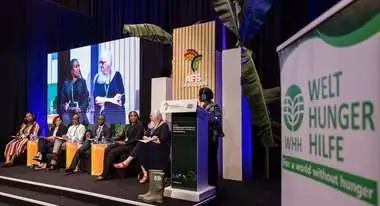
Welthungerhilfe presents the 2026 Global Hunger Index
Global hunger is rising again as wars threaten food security worldwide, new report warns

2026 Global Hunger Index: Hunger has worsened in 32 countries, while 57 countries are unlikely to reach even low hunger levels by 2030 – food security must become part of security policy.
Bonn/Berlin, October 14, 2026. Global hunger is rising again after almost two decades of progress, with wars, climate shocks, and economic crises driving a reversal in efforts to end hunger, according to the 2026 Global Hunger Index (GHI), released today.
Hunger has worsened in 32 countries, while 57 countries are on track to miss even a low level of hunger by 2030. The report, published jointly by Welthungerhilfe, the Institute for International Law of Peace and Armed Conflict (IFHV) at Ruhr University Bochum, and the Swiss organization Helvetas, warns that food security must become a central part of security policy as conflicts threaten livelihoods and food systems far beyond the front lines.
Press download
"The fact that 645 million people worldwide are going hungry should serve as a wake-up call. We still think about security primarily in military terms, yet food security is essential to peace and stability. War drives hunger, and hunger can fuel further conflict. Today's wars are also threatening food security far beyond the countries where they are being fought," says Marlehn Thieme, President of Welthungerhilfe.
The impact of today's wars extends far beyond the front lines. The war in Iran and disruptions to shipping through the Strait of Hormuz, alongside escalating tensions around the Bab el-Mandeb Strait, are driving up fuel, transportation, and fertilizer costs. Meanwhile, Russia's war against Ukraine and restrictions on grain exports through the Black Sea threaten further increases in wheat prices. For families in the Global South, already struggling with high living costs, even basic food supplies are becoming increasingly unaffordable.
Sub-Saharan Africa remains particularly affected, with seven of the eight countries facing alarming levels of hunger located in the region. Somalia records the highest GHI score, while El Niño threatens to further worsen food insecurity. Yet progress is possible: Countries such as Uganda and Nepal have reduced hunger through political stability and sustained investment in nutrition, health care, education, and sanitation.
"Cutting investment in food security and crisis preparedness today risks creating even greater humanitarian emergencies and instability tomorrow. Germany must reverse cuts to development cooperation and humanitarian assistance and recognize food security as an essential part of its foreign, peace, and security policies," says Mathias Mogge, Secretary General of Welthungerhilfe.
Welthungerhilfe is calling for reliable, long-term investment in sustainable agriculture, resilient food systems, and social protection, alongside stronger diplomatic efforts to resolve conflicts and uphold international humanitarian law.
Mogge also stresses the devastating consequences of restricted humanitarian access in conflict zones: "I have seen for myself in Gaza how much people's survival depends on whether humanitarian aid can reach them."

Notes to Editors
The Global Hunger Index (GHI) is one of the world's most comprehensive tools for measuring and tracking hunger at global, regional, and national levels. The 2026 report, No Security Without Food Security, examines the links between hunger, conflict, and security, highlighting the need to make food security a central consideration in security policy.
Welthungerhilfe is one of the largest private aid organizations in Germany; it is politically independent and non-denominational. With courage and determination, it is striving for a world without hunger. Since it was founded on December 14, 1962, 13,424 international projects in about 72 countries and territories have been supported with 5.76 billion euros. Welthungerhilfe follows the principle of empowering people to help themselves to sustainably improve their living conditions, through approaches ranging from fast disaster relief to reconstruction and long-term development cooperation projects with national and international partner organizations.
Categories