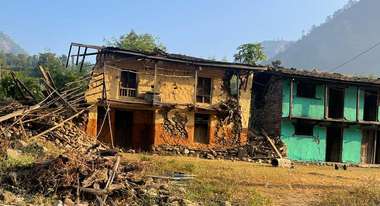
Nepal Flash Flood: Welthungerhilfe (WHH) Supports Survivors in Mountain Regions
Growing Risk of Disease as Rainy Season Continues


Bonn/Berlin/Kathmandu, September 8, 2026. Two weeks after a massive flash flood swept through the Bhotekoshi Valley, carrying away people, animals and houses and destroying roads, bridges and hydropower plants, Welthungerhilfe (WHH) is providing assistance to survivors in hard-to-reach areas. Many remote settlements in Rasuwa District, on the border with Tibet, can now only be reached by helicopter. The main road through the valley, an important link between Nepal and China, has been washed away in large sections. Smaller, unpaved roads higher up in the mountains do not provide access to all settlements.
“Initial relief measures have primarily reached the areas near the capital Kathmandu that are easier to access. But people in very remote locations are in some cases still waiting for the essentials – they are gradually running out of food,” reports Katja Dombrowski, who is on the ground as a member of the emergency relief team together with local staff. Emergency assistance in Nepal is therefore concentrated on food parcels for the time being. Three four-wheel-drive trucks carrying 10.5 metric tons of staple foods such as rice, lentils, oil, and salt have reached a collection point in Rasuwa after a 14-hour journey along muddy tracks. From there, further distribution is being organized in coordination with the government.
“Next, we’ll be working with our local partners to ensure a supply of hygiene products,” says Katja Dombrowski. “We’re now procuring items such as soap, toothbrushes and toothpaste, washing powder, towels and sanitary towels – everything that’s urgently needed for personal hygiene.” Under the current circumstances, an adequate supply of hygiene items is also vital for reducing the risk of disease.
Biju Dangol, an expert in water, sanitation and hygiene at WHH in Nepal, has visited several emergency shelters in Rasuwa and reports extremely difficult hygienic conditions. “Some children are already suffering from diarrhoea. There is a very high risk of waterborne diseases spreading,” she warns. “The risk is particularly high now that the rainy season has begun.” E. coli bacteria have already been found in drinking water in Nuwakot District, just south of Rasuwa.
Whilst the emergency relief effort is underway, attention is already turning to winter. “In a few weeks’ time, temperatures in the higher-altitude regions of the Himalayas will drop drastically, says Katja Dombrowski. “Many people are likely to still be living in makeshift shelters by then and will need warm clothing, hats, scarves and sleeping bags to protect them from the frost. We are already preparing for these needs.”
WHH has been working in Nepal, with some interruptions, since 1972, in collaboration with national and international partner organizations on the ground. With a country office in the capital and Nepalese partners, the organization carries out projects focused in particular on food security. The work also centres on disaster preparedness, humanitarian assistance and the strengthening of civil society.
Katja Dombrowski, WHH’s Emergency Relief Communications Officer, is available for interviews from Kathmandu. She can provide first-hand information on the situation on the ground and the ongoing relief efforts.
Welthungerhilfe is one of the largest private aid organizations in Germany; it is politically independent and non-denominational. With courage and determination, it is striving for a world without hunger. Since it was founded on December 14, 1962, 13,424 international projects in about 72 countries and territories have been supported with 5.76 billion euros. Welthungerhilfe follows the principle of empowering people to help themselves to sustainably improve their living conditions, through approaches ranging from fast disaster relief to reconstruction and long-term development cooperation projects with national and international partner organizations.