In cooperation with local and international partners, WHH has developed a diverse WASH portfolio covering both humanitarian and development contexts. Prioritizing the user, addressing sustainability through a systems strengthening approach
When Water Runs Short: Building Resilience in Kenya’s Tana River County
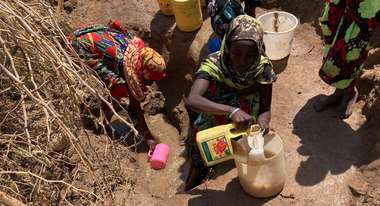
Tana River County takes its name from Kenya’s longest river, which winds through the county before reaching the Indian Ocean. Yet communities across this vast landscape continue to grapple with a striking contradiction: recurrent drought and severe water scarcity, punctuated by periods of destructive flooding.

For families whose livelihoods depend largely on pastoralism, agro-pastoralism, mixed farming and fishing, these recurring climate shocks affect far more than access to water. Poor rainfall reduces crop production and strains livestock, while dwindling water sources place additional pressure on households already struggling to meet their basic needs. When floods come, they can bring a different kind of disruption—damaging livelihoods, infrastructure and access to essential services.
Welthungerhilfe (WHH) is among the humanitarian organisations working alongside communities and government in Tana River. Through United States Government funding coordinated by the United Nations Office for the Coordination of Humanitarian Affairs (UNOCHA), WHH is working as part of a consortium of partners, in collaboration with the County Government of Tana River, to deliver complementary assistance to drought-affected communities.
A county of challenges – and opportunities
The challenges facing Tana River are significant, but so too are the opportunities to strengthen essential services and build more resilient livelihoods.
During a recent engagement with humanitarian partners, Mwanajuma Hiribae Mabuke, Acting County Secretary for the County Government of Tana River, reflected on both the county’s current gaps and its ambitions for the future.
Mwanajuma Hiribae Mabuke estimated that water coverage currently stands at around 50 per cent, against the county’s ambition of reaching 100 per cent by 2030. She also highlighted gaps in health and sanitation services, including health facilities that remain unconnected to the national electricity grid.
With the Tana River flowing through the county, Mwanajuma Hiribae Mabuke pointed to the potential for expanding small-scale irrigation to strengthen agricultural production and livelihoods. She also highlighted opportunities to invest further in renewable energy.
The potential of irrigation is already visible in places such as the Bura Irrigation Scheme, where water from the Tana River supports agricultural production.
The same river that gives Tana River County its name could therefore also be part of the solution to some of the challenges created by a changing and increasingly unpredictable climate.

Responding to interconnected needs
The response is being implemented through a consortium involving Welthungerhilfe (WHH), UNICEF, ACTED, Arid Lands Development Focus (ALDEF), the Kenya Red Cross Society (KRCS), and the Pastoralist Girls Initiative (PGI), in collaboration with the County Government of Tana River and relevant National Government institutions.
Together, the response connects support across water, sanitation and hygiene (WASH), health and nutrition, cash assistance, community engagement and other essential services.
For WHH, improving access to safe water is a central part of that contribution.
Through the WASH-response project, the consortium aims to provide life-saving WASH assistance to approximately 107,000 drought-affected people, particularly in communities and hotspots where access to safe water remains limited.
The intervention includes major and minor rehabilitation of key boreholes to improve water supply for households, schools and health facilities, alongside water-quality testing and treatment. Around 6,800 vulnerable households are also targeted with essential WASH non-food items.
But infrastructure alone cannot create lasting change. Community hygiene promotion is being delivered through outreach and radio messaging, while Water User Committees are being strengthened to support the operation and basic maintenance of water systems beyond the immediate project period.
Listening to the people behind the numbers
A recent joint monitoring mission brought representatives of UNOCHA, UNICEF, implementing partners and the County Government of Tana River closer to the communities at the centre of the response.
The visit provided an opportunity to hear directly from families about what drought means in their everyday lives.
In Safaricom Village, for example, women described households stretching very limited incomes across food, water and other basic necessities. Some families purchase a 20-litre jerrican of water for KES 25, a significant expense when livelihood opportunities are scarce.
The distances involved in accessing essential services add another layer of difficulty. Women also spoke about the consequences when emergency maternal healthcare is too far away, including experiences of miscarriages and stillbirths when timely care could not be reached.
Food is another daily concern. During the height of the drought, community members said some families survived on one meal a day. One woman described how an entire acre planted with green grams yielded barely two kilograms after poor rains.
These individual experiences reveal what drought statistics can sometimes obscure: water scarcity is rarely only a water problem. It affects what families eat, how they earn an income, their health and hygiene, how children experience education.

When different forms of support come together
The monitoring visit also demonstrated why complementary interventions matter.
For communities, these interventions are experienced not as separate project components but as different parts of daily life.
A household with safer water can practise better hygiene. A health outreach can reach a child who might otherwise miss essential services. Cash assistance can give a family temporary room to prioritise food and other immediate needs. A functioning borehole can reduce the time and money spent searching for water.
This is where an integrated response can make a meaningful difference.

From immediate response to longer-term resilience
The work in Tana River is far from finished.
Some water infrastructure remains under development, and communities continue to face the effects of recurrent drought, limited livelihood opportunities and gaps in access to essential services. Yet the response also offers an opportunity to look beyond the immediate emergency.
For humanitarian partners, it means ensuring that emergency investments contribute wherever possible to stronger community systems and longer-term resilience.
And for communities themselves, the priorities can be remarkably straightforward.
As one woman in Safaricom Village explained, bringing water closer to the community could do more than reduce the daily search for water. It could strengthen food security, improve livelihoods and create better opportunities for their children.
In Tana River, where drought and floods repeatedly test the resilience of communities, water is not simply a basic service. It connects health, food, livelihoods and dignity—and could be one of the foundations on which a more resilient future is built.
Categories